
How to Recruit SaaS Affiliate Partners
M
By Matthew
Referral tracking and attribution writer
Published November 19, 2026 · Last updated November 19, 2026

By Matthew
A SaaS affiliate program can attract dozens of sign-ups and still produce very few paid subscriptions. The usual cause is a weak match between the partner’s audience and the product’s buyer, followed by generic outreach and an unclear first promotion.
To recruit SaaS affiliate partners effectively, build a narrow partner profile, approach people with audience evidence, give them a commercially sound offer, and support their first campaign. ReferClaw can handle the tracking side once the recruitment process is ready.
Quick answer: how to recruit SaaS affiliate partners
Use this workflow to recruit partners who can generate qualified SaaS referrals:
- Define the buyer, use case, and partner audience you want to reach.
- Build a prospect list from creators, consultants, communities, agencies, and integration educators.
- Qualify each prospect by audience fit, content quality, buyer intent, and promotion history.
- Send personal outreach built around one relevant content angle and a specific offer.
- Set a commission, attribution window, and partner terms that work with your unit economics.
- Onboard approved partners with links, product access, proof points, and a first promotion plan.
- Review activated partners each month and invest more support in those producing qualified trials and paid accounts.
Define the SaaS affiliate partner profile before you start outreach
Start with the people your SaaS needs to reach. “Marketing creators” is too broad for a useful recruitment plan. A partner profile needs a clear audience, an established format, and a reason that audience would care about your product.
Use this illustrative example throughout: a reporting SaaS sells a $79 monthly plan to small ecommerce brands. Its best users run Shopify stores, manage paid social ads, and need weekly performance reporting. The team initially invited broad business newsletters. Those audiences showed interest but generated few trials because the content rarely addressed ecommerce reporting problems.
The team tightened its target to Shopify consultants, ecommerce operators who publish tutorials, niche newsletters for store owners, and agencies that build reporting dashboards. Each type reaches buyers at a different moment.
| Partner type | Audience signal to check | Best promotion format | First outreach angle |
|---|---|---|---|
| Ecommerce consultant | Works with active Shopify stores | Client resource page or implementation guide | Show how the product solves a recurring reporting task |
| Tutorial creator | Publishes Shopify, ads, or analytics walkthroughs | Product tutorial or comparison video | Offer a test account and a practical workflow to demonstrate |
| Niche newsletter | Readers include operators and growth leads | Curated tool recommendation or sponsored placement | Pitch one timely pain point for store owners |
| Ecommerce agency | Manages analytics or paid media for clients | Partner resource hub or client onboarding package | Frame the product as a service delivery aid |
| Community operator | Members ask operational questions | Workshop, template, or member offer | Run a focused session on reporting workflows |
Write one sentence that describes the ideal partner: “An educator or service provider whose audience actively manages Shopify stores and needs clearer paid-media reporting.” That sentence guides prospecting, outreach, and approval decisions.
For a broader view of the program structure behind recruitment, use this guide on how to start an affiliate program for SaaS.
Separate affiliates from customer referrers
Customer referrals and affiliate recruitment need different messages. Customers share a product they use. Affiliates usually need a content angle, reliable tracking, a commission model, and resources that help them recommend the product responsibly.
Keep these motions in separate lists, separate email sequences, and often separate rewards. The practical differences are covered in SaaS referral program software: affiliate vs customer referrals.
Find and qualify SaaS affiliate partners with evidence
Build a working list of 50 to 100 prospects before sending the first emails. This protects the team from spending each day searching for the next contact and makes it easier to compare partner quality.
Search YouTube, podcasts, newsletters, LinkedIn, community directories, agency websites, integration marketplaces, and product comparison articles. Record the prospect’s URL, contact, audience description, typical content format, recent relevant posts, estimated promotion opportunity, and a personal outreach observation.
For the reporting SaaS example, a useful prospect has recently published content around Shopify analytics, Meta ads reporting, ecommerce dashboards, or agency reporting. A large general entrepreneurship account may have more followers and less commercial relevance.
Use a simple three-part qualification score:
- Audience fit: Does the partner reach people who buy, influence, or implement your SaaS?
- Intent signal: Does their content solve problems close to the one your product solves?
- Execution signal: Have they published useful tutorials, recommendations, newsletters, or client resources consistently?
Review a prospect’s last 10 pieces of content. Look for recurring questions from the audience, quality of product recommendations, and whether calls to action lead readers toward a sensible next step. Export the list into a shared sheet and rank prospects before outreach begins.
Send outreach that gives each partner a credible reason to reply
A first email should show that you know the partner’s work and have a relevant opportunity. The partner needs enough detail to assess audience fit without reading a full program manual.
For the ecommerce reporting SaaS, an email to a Shopify tutorial creator could read:
> Hi [Name], your guide on weekly Shopify and Meta reporting gives store owners a clear process for spotting campaign issues. We built a reporting tool for the same workflow, including a weekly view for store and ad performance. We are inviting a small group of ecommerce educators to our affiliate program and can provide a full account for testing. Partners earn 25% of subscription revenue for 12 months on paid accounts they refer. Would a short product walkthrough and a custom tracking link be useful?
This works because it names a specific piece of work, connects the offer to the creator’s audience, and states the commercial terms early.
Follow up once after five to seven business days with a fresh detail, such as a relevant template, a new tutorial angle, or an invitation to test the product. Then move on. Recruitment depends on steady, well-targeted volume rather than repeated pressure on a single contact.
Track outreach status in stages: identified, researched, contacted, replied, approved, activated, and producing. “Activated” should mean the partner has published, emailed, hosted, or otherwise distributed a promotion. A signed-up affiliate has not yet created distribution.
Set SaaS affiliate incentives that partners can explain
The commission needs to motivate the partner while leaving room for acquisition cost, support, refunds, and gross margin. For the $79 monthly reporting plan, a 25% recurring commission pays $19.75 per active referred customer each month. Over a 12-month commission term, that reaches up to $237 for a customer who remains subscribed throughout the period.
State these terms plainly in the partner agreement and onboarding materials:
- Commission percentage or fixed reward
- Commission duration for recurring subscriptions
- Attribution window
- Payout timing and minimum threshold
- Treatment of refunds, cancellations, and self-referrals
- Rules for paid search, coupons, and brand bidding
A flat bounty can suit a product with a short retention period or a fast sales cycle. A recurring commission often suits SaaS because it aligns partner earnings with retained subscriptions. Read how to set up recurring affiliate commissions for a SaaS product before choosing the duration.
Give partners a benefit they can communicate beyond the commission. For example, the reporting SaaS can offer a two-week account to test, a dashboard template for their readers, and early access to a new ecommerce reporting feature. A better audience offer improves conversion quality.
Onboard SaaS affiliate partners for their first promotion
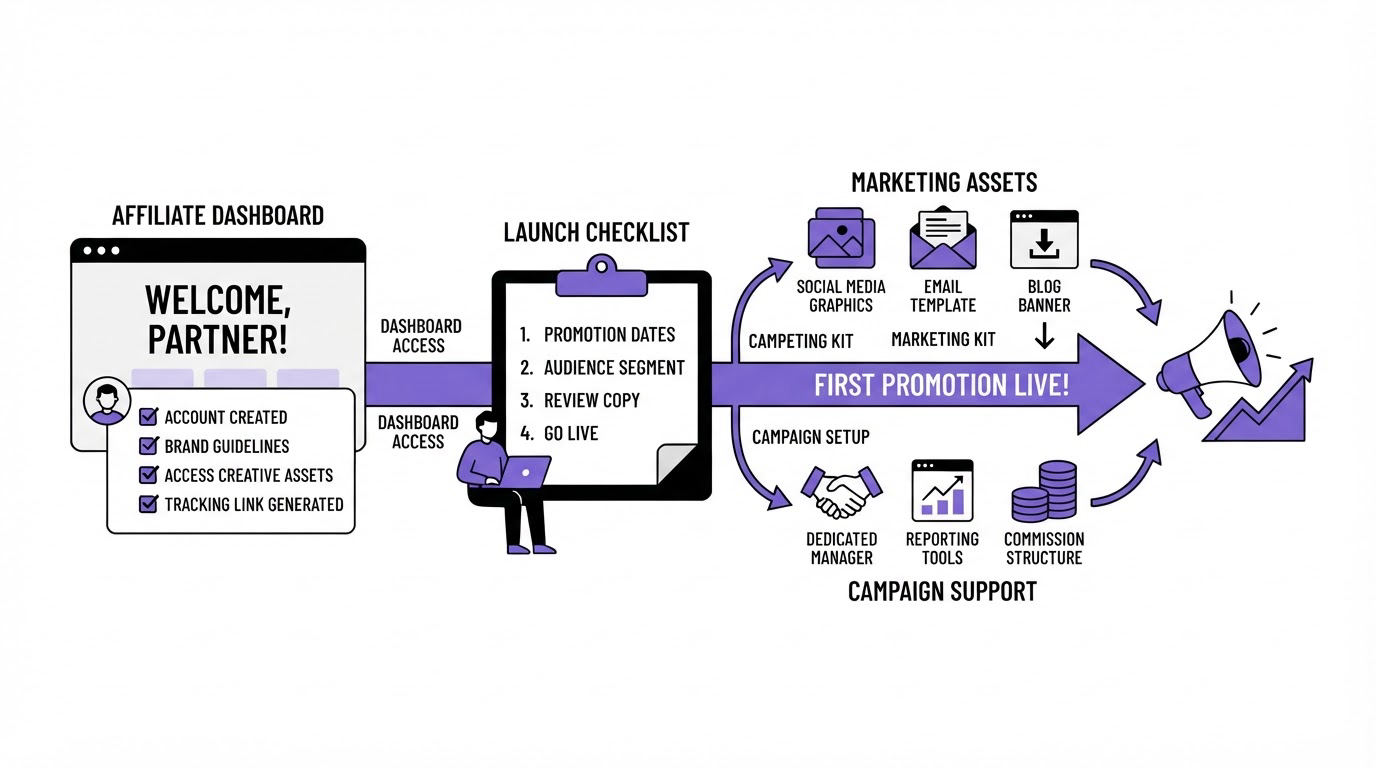
Fast onboarding produces more active partners. Send the essentials within one business day of approval, then schedule support around the partner’s publishing process.
Give each approved partner a welcome page or email with their tracking link, login instructions, product positioning, core use cases, commission terms, disclosure guidance, and direct support contact. Include three content-ready ideas tailored to their format.
For the reporting SaaS, a tutorial creator could receive these first-promotion choices: a walkthrough of a weekly reporting routine, a comparison of manual spreadsheet reporting versus a dashboard, or a template-led video for setting up ecommerce KPI tracking. An agency could receive a client reporting checklist and a referral link for its resource library.
Ask for a publication date or next step. A vague “let us know if you need anything” leaves the work open-ended. A concrete question moves the relationship forward: “Which of these three angles best fits your next content slot?”
Partners also need clear disclosure guidance. The FTC explains that endorsements require clear disclosure of material connections in its Endorsement Guides. Provide a simple disclosure example appropriate to the partner’s channel and ask them to place it near the recommendation.
How ReferClaw supports SaaS affiliate partner recruitment
Recruitment still requires research and personal conversations. ReferClaw reduces the operational work after a prospective partner accepts the offer.
First, set the commission structure that you offered in outreach, including recurring terms where they fit your model. Keep the emailed offer and configured rules aligned. A partner who sees different terms after joining may abandon the process.
Next, create the partner’s referral link and give them a direct route to the pricing page, trial page, or use-case landing page that matches their content. For the reporting SaaS, a Shopify tutorial should point to a page focused on ecommerce reporting rather than the general homepage.
Then connect Stripe so subscription events can be attributed to the referral source. Stripe uses webhooks to notify systems about events, and its webhook documentation explains the event-based model behind subscription status updates. ReferClaw’s Stripe-focused setup is covered in Stripe affiliate program software: how to track SaaS referrals.
Finally, review referred trials, paid conversions, recurring commissions, and partner-level performance in one operating view. This lets the team see whether the Shopify creator’s tutorial brings qualified subscribers, whether the agency referral page needs better enablement, or whether a newsletter audience needs a different landing page.
Review SaaS affiliate partner performance every month
Run a monthly review with a small set of metrics: clicks, trials, paid subscriptions, trial-to-paid conversion, retained subscription value, refunds, and activated partners. Use these measurements to decide where the next month’s support goes.
In the example, suppose a newsletter sends 300 clicks and two trials, while a smaller tutorial sends 80 clicks and eight trials. The tutorial partner deserves a closer look. Check the landing page, audience comments, and trial activation behavior before offering more resources or a co-created campaign.
Review program economics quarterly as well. The affiliate program pricing guide for SaaS can help frame the software and commission costs around the program’s actual contribution.
Common mistakes when recruiting SaaS affiliate partners
The biggest failure mode is accepting anyone who asks for an affiliate link. That produces an unmanageable partner list, weak attribution data, and little useful learning. Use the partner profile and qualification score from the start.
Another common problem is an offer that creates a signup but no first promotion. Fix this with a partner-specific content angle, a product account, and a defined next action during onboarding.
Teams also lose strong partners by treating the program as a one-time setup project. Send product updates that affect the partner’s audience, share useful conversion feedback, and create new promotion angles when seasonal demand or product releases make them relevant.
FAQ
How many SaaS affiliate partners should I recruit first?
Recruit 10 to 20 well-qualified partners for an initial cohort. This range gives you enough feedback across partner types while leaving room for personal onboarding. Expand after you understand which audiences, offers, and landing pages create paid subscriptions.
What commission should a SaaS affiliate program offer?
Base the rate on gross margin, expected retention, acquisition cost limits, and the level of effort required from the partner. Recurring commissions often fall within a defined duration, such as 6 or 12 months. Put the full calculation into a simple model before publishing terms.
Should I approve every affiliate application?
Use an approval process based on audience fit, content relevance, and promotion quality. A narrower partner group makes it easier to provide useful enablement and interpret performance data.
Where can I find SaaS affiliate partners?
Look for niche creators, consultants, agencies, newsletter operators, community hosts, integration educators, and comparison-site publishers that already serve your ideal customer. Search by the buyer’s problem and job title, then evaluate the audience before contacting the publisher.
How long does SaaS affiliate recruitment take?
Plan for several weeks to build the list, send personal outreach, handle replies, and support first promotions. The first month should focus on recruitment and activation. Meaningful performance patterns appear after partners have had time to publish and referred users have time to convert.
A SaaS team that can commit to personal outreach, a clear offer, and monthly partner support should start with a focused cohort. Set up the program rules and tracking in ReferClaw, recruit against a specific audience profile, and use the first cohort’s conversion data to guide the next one.