
How to Set Up Recurring Affiliate Commissions for a SaaS Product
C
By Chloe
SaaS affiliate program specialist
Published November 17, 2026 · Last updated November 17, 2026
By Chloe
A partner refers a customer who starts a $99 monthly plan. Three months later, the customer upgrades, then requests a partial refund. Your affiliate program needs rules that determine whether the partner earns on each payment, the upgrade, and the refunded invoice before a dispute reaches your inbox.
Recurring commissions can create durable partner incentives, provided that your billing events, attribution, and exception handling are written before launch. ReferClaw helps SaaS teams build and manage affiliate programs around those commercial rules.
Quick answer: how to set up recurring affiliate commissions
- Choose the commission base, rate, duration, and eligible subscription plans.
- Define the subscription events that create, adjust, or reverse a commission.
- Set an attribution window and a clear rule for ownership when several sources touch a conversion.
- Add refund, cancellation, failed-payment, and chargeback rules to your terms.
- Connect commission records to confirmed billing data and hold payouts until the refund period passes.
- Give partners a plain-language program guide before they begin promoting.
How recurring affiliate commissions work for SaaS subscriptions
A recurring commission pays an affiliate when a referred customer makes qualifying subscription payments over time. The key word is qualifying. Your program terms determine which revenue counts and how long a partner remains eligible.
Start by choosing four commercial settings:
| Rule to set | Example policy for a SaaS product | Operational effect |
|---|---|---|
| Commission rate | 25% of net subscription revenue | A $99 monthly payment creates a $24.75 commission before reversals |
| Commission duration | First 12 paid months | Limits long-term liability while rewarding retention |
| Eligible products | Core monthly and annual plans | Keeps one-time services and add-ons outside the program unless explicitly included |
| Payout hold | 30 days after each paid invoice | Gives refunds and payment disputes time to surface |
| Attribution window | 30 days after an affiliate click | Defines how long a referral can convert and remain credited |
| Currency and tax basis | Net revenue after refunds, credits, and taxes | Creates a consistent calculation basis across invoices |
Use net revenue as the base when your billing system applies refunds, credits, coupons, and sales tax. Gross revenue is easier to explain at first glance, yet it can leave your company paying commissions on money later returned to the customer.
Carry one example through your design. Imagine TeamNest, a project-management SaaS, pays 25% of net subscription revenue for a customer’s first 12 successful monthly payments. Affiliate Maya refers Daniel on January 5. Daniel begins a $99 monthly plan on January 20. Maya earns $24.75 once the payment clears and the 30-day hold ends.
If Daniel upgrades to a $199 plan in April, TeamNest needs a written upgrade policy. A straightforward choice pays 25% of the actual net amount collected on each future invoice, so Maya’s commission rises with the plan. Teams that prefer predictable acquisition costs can instead cap commissions at the original plan value. State the choice directly in your partner agreement.
For wider planning beyond commission structure, see Affiliate Program Pricing for SaaS: Revenue Share vs Monthly Plans.
How to set up recurring affiliate commissions step by step
1. Define qualifying revenue before configuring tracking
Write a one-page commission policy first. Include the commission percentage, eligible plans, duration, payout schedule, and the revenue figure used for calculation. Decide whether discounts reduce the commissionable amount. Most SaaS programs calculate on the amount actually paid after a promotional discount.
TeamNest offers Daniel a 20% launch discount, making his first invoice $79.20. Under a net-revenue policy, Maya earns $19.80 for that month. The calculation follows money collected, which keeps finance records and partner expectations aligned.
Annual plans need their own choice. You can pay the full commission after the annual invoice clears, or spread the commission across monthly periods. A full payment attracts partners because earnings arrive earlier. A monthly accrual reduces refund exposure. Use the approach that matches your refund terms and cash flow.
2. Map every subscription event to a commission outcome
Billing platforms produce several events across a subscriber’s lifecycle. Treat each one as a business rule, rather than assuming every invoice creates an eligible commission.
For TeamNest, a successful first payment creates a pending commission. A renewal creates another pending commission while Daniel remains inside the 12-month eligibility period. An upgrade changes the amount on future commissions. A cancellation stops future commissions after the final paid service period ends.
Document the following events in your operating procedure:
- First successful subscription payment
- Renewal payment
- Plan upgrade or downgrade
- Refund or account credit
- Failed payment, delinquency, and recovery
- Cancellation, reactivation, or chargeback
Use your payment provider’s confirmed billing records as the financial source of truth. For Stripe-based subscriptions, Stripe’s subscription webhook guidance explains which event notifications help track subscription changes and invoice payment outcomes. Test these event paths with a trial customer before inviting affiliates.
3. Choose an attribution window and conflict policy
The attribution window determines how long an affiliate click can lead to an attributed signup. Thirty days is common for a self-serve SaaS purchase, while products with longer evaluation cycles may need 60 or 90 days. The right window follows your actual time from first visit to paid conversion.
Export the last 90 days of new-customer data first. Compare first visit, trial start, and first paid invoice dates. If most customers convert within two weeks, a 30-day window gives partners a fair opportunity without keeping attribution open indefinitely.
You also need an ownership rule. A last-click policy credits the most recent eligible affiliate click. A first-click policy credits the partner who introduced the buyer. Some teams protect an affiliate’s referral once a trial begins, which prevents a later promotional click from moving credit. Put the rule in writing and apply it consistently.
TeamNest chooses a 30-day last-click window, then locks Maya’s attribution when Daniel starts a trial. Daniel can still receive emails and paid-search ads from TeamNest. Those later interactions do not move the referral away from Maya.
Read Stripe Affiliate Program Software: How to Track SaaS Referrals for a closer look at connecting referral attribution with SaaS billing records.
Refunds, cancellations, and failed payments in recurring affiliate commissions
Refunds and cancellations create the most avoidable affiliate disputes. Solve them with precise timing rules.
A refund should reverse the commission connected to the refunded amount. If a payout has already occurred, your terms can allow a debit against future approved earnings. Explain this before partners join. Retroactive policy changes create friction quickly.
A cancellation should end commissions when paid access ends. Consider Daniel’s TeamNest subscription: he pays for May, cancels on May 10, and retains access through May 31. Maya earns the May commission because the invoice succeeded. No June renewal exists, so no June commission accrues.
Failed payments need a pending state. Do not approve a commission from an invoice that remains unpaid. If Daniel’s card fails on June 20 and succeeds after an automated retry on June 25, create the commission only after the successful payment. If the account becomes delinquent and later churns, no commission is due for that renewal.
Chargebacks deserve a separate clause because they can appear long after the original payment. Reverse the associated commission once the chargeback is confirmed, then keep an audit note containing the invoice ID, date, amount, and reason. This protects your finance team when a partner asks for a review.
Use ReferClaw to run recurring affiliate commission rules consistently
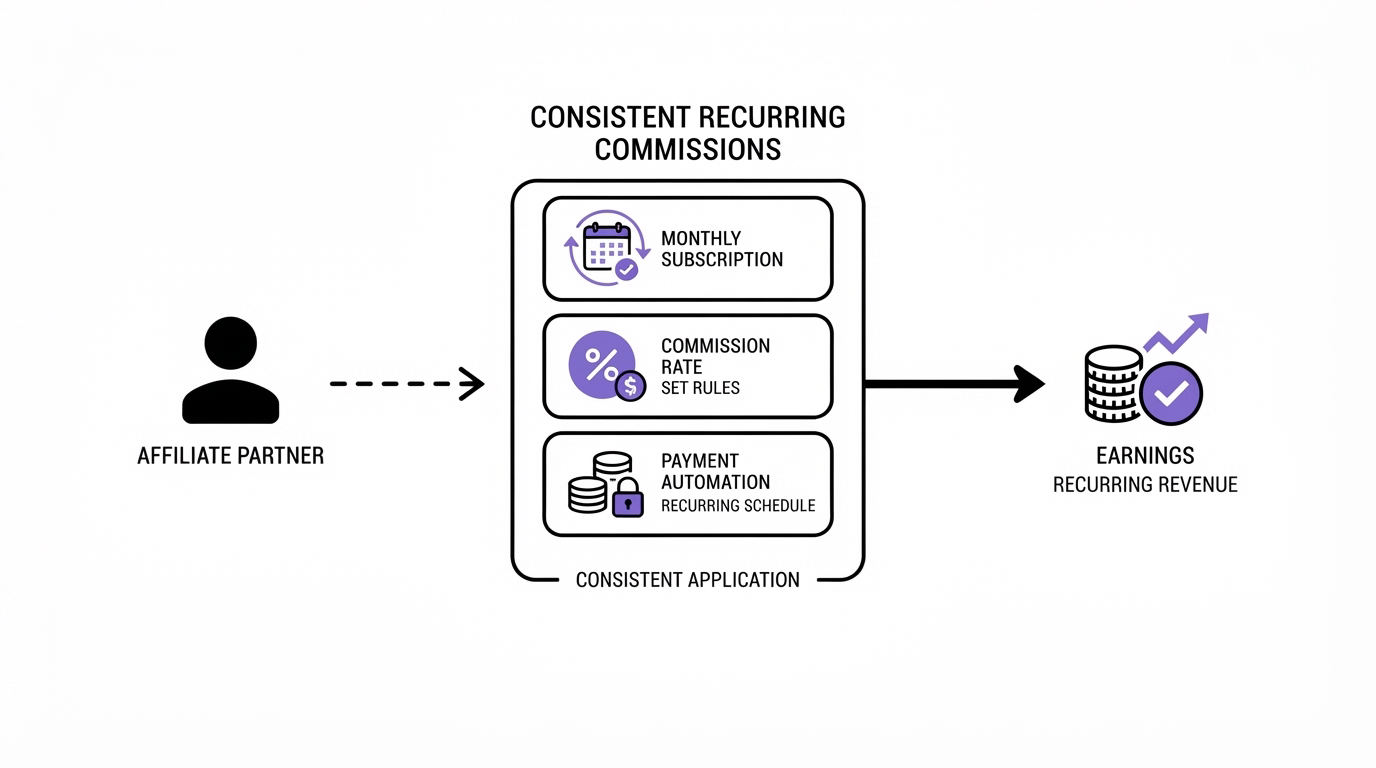
Recurring programs become difficult when commission policy sits in a spreadsheet, billing data sits elsewhere, and each exception is resolved from memory. ReferClaw gives a SaaS team a central workflow for its affiliate program, so the rules above can be applied in a repeatable process.
Begin by entering the program’s commercial terms: eligible plans, commission percentage, attribution period, and commission duration. Next, align the program with the billing events that mark a conversion and a successful renewal. Review a test referral before launch, including the initial payment, a plan change, a refund, and a cancellation.
Then publish the partner-facing terms from the same policy your team uses internally. When a refund or billing exception occurs, review the original referral, invoice history, and policy clause together. That process reduces improvised decisions and gives support staff a consistent answer.
Teams comparing operating models can use the ReferClaw comparison pages alongside the detailed guide to SaaS affiliate program software features, costs, and setup. The useful question is whether the platform supports the exact subscription and exception rules your program intends to enforce.
How customer support helps retain good affiliate partners
Affiliate questions often arrive at the least convenient moment: a partner sees a missing renewal, a customer’s card failed, or a commission changed after a refund. A clear support process protects trust because partners can get an explanation before a small billing issue becomes a public complaint.
For example, TeamNest could route affiliate questions through a shared inbox with tags for “missing conversion,” “renewal,” “refund,” and “payout.” The support agent checks the referral record, confirms the relevant invoice event, and replies with the policy rule and expected resolution date. Repeated questions then become articles in a help center, reducing manual back-and-forth for future partners.
A customer support platform with live chat, a shared inbox, and knowledge base tools can support that workflow when affiliates and customers need fast answers from the same team. Website live chat is especially useful during program onboarding, while a help center gives partners a permanent place to check attribution windows, payment holds, and refund treatment. Keep commission approvals with the program owner and use support conversations to surface exceptions early.
How to communicate recurring commission terms to partners
Send partners a concise program guide before approving their first promotion. Avoid legal language where a plain operational sentence will do. Partners need to know when commission starts, what amount it is based on, when they receive payment, and which events can change an earned amount.
TeamNest’s guide would say: “You earn 25% of net payments from customers you refer for their first 12 paid monthly invoices. Commissions are approved 30 days after payment. Refunds, credits, chargebacks, and unpaid invoices reduce or reverse the related commission.” That paragraph answers the questions partners ask most often.
Add examples for an upgrade and a cancellation. Include a contact route for disputes, plus a reasonable review window such as 14 days after a commission status changes. Keep a version date at the top of the terms. When rules change, notify partners before the effective date and retain the prior version for reference.
Disclosure rules also belong in partner onboarding. The Federal Trade Commission’s endorsement guidance explains that material connections should be clearly disclosed in social media and other endorsements. Give affiliates sample disclosure language that fits their usual channels.
FAQ about recurring affiliate commissions
How long should recurring affiliate commissions last?
Twelve months is a practical starting point for many SaaS products because it rewards partners for customer quality while putting a clear ceiling on acquisition cost. Lifetime commissions can attract ambitious partners, though they require strong retention economics and careful treatment of upgrades, pauses, and reactivations.
Should affiliates earn commission on upgrades?
Paying on upgrades encourages partners to refer customers with room to grow. Use the net amount actually collected on the upgraded plan, and keep the original commission duration unless your terms specify an extension. TeamNest’s 12-month clock begins on Daniel’s first paid invoice and continues through that period after his upgrade.
What happens when a referred customer pauses and later reactivates?
Define whether the original attribution resumes and whether paused time counts toward the commission duration. A simple policy keeps the original duration calendar-based. If Daniel pauses for two months, Maya receives no commission during the unpaid period and the 12-month eligibility window continues to run.
How do I launch an affiliate program for a SaaS product?
Set the commission economics, attribution model, partner terms, tracking workflow, and support ownership before recruitment. How to Start an Affiliate Program for SaaS covers the broader launch sequence, including partner recruitment and program operations.
Can customer referrals and affiliate referrals use the same rules?
They usually need separate incentives and communications. Affiliates promote as a business activity and often expect recurring revenue share. Customers typically respond better to a one-time credit, discount, or reward. See SaaS Referral Program Software: Affiliate vs Customer Referral Programs before combining both audiences under one set of terms.
A recurring affiliate program works when every payment outcome has an assigned rule and partners can understand that rule without asking for an exception. Set the policy, test the full subscription lifecycle, and launch only after your billing, support, and program owners agree on the same answers.