
SaaS Referral Program Software: Affiliate vs Customer Referral Programs
C
By Chloe
SaaS affiliate program specialist
Published November 10, 2026 · Last updated November 14, 2026
By Chloe
A SaaS team can spend weeks recruiting affiliates while overlooking its strongest source of qualified leads: customers who already understand the product. The reverse also happens. A customer referral offer gets launched, then stalls because few users have the reach or publishing discipline required to create steady demand.
ReferClaw helps SaaS teams run referral programs tied to subscription revenue. The right starting point is choosing the promotion model, then designing rewards and attribution around that model.
Quick answer: how to choose SaaS referral program software
Use this workflow to choose and launch the right program:
- Define whether growth depends on customer advocacy, external audience reach, or both.
- Create separate affiliate and customer referral offers with incentives suited to each promoter.
- Set attribution rules before publishing links, codes, or referral forms.
- Connect subscription and payment events so recurring rewards follow real revenue.
- Build an approval, fraud-review, support, and payout process.
- Review referral quality by promoter type after the first billing cycles and adjust the offer.
Affiliate vs customer referral programs for SaaS
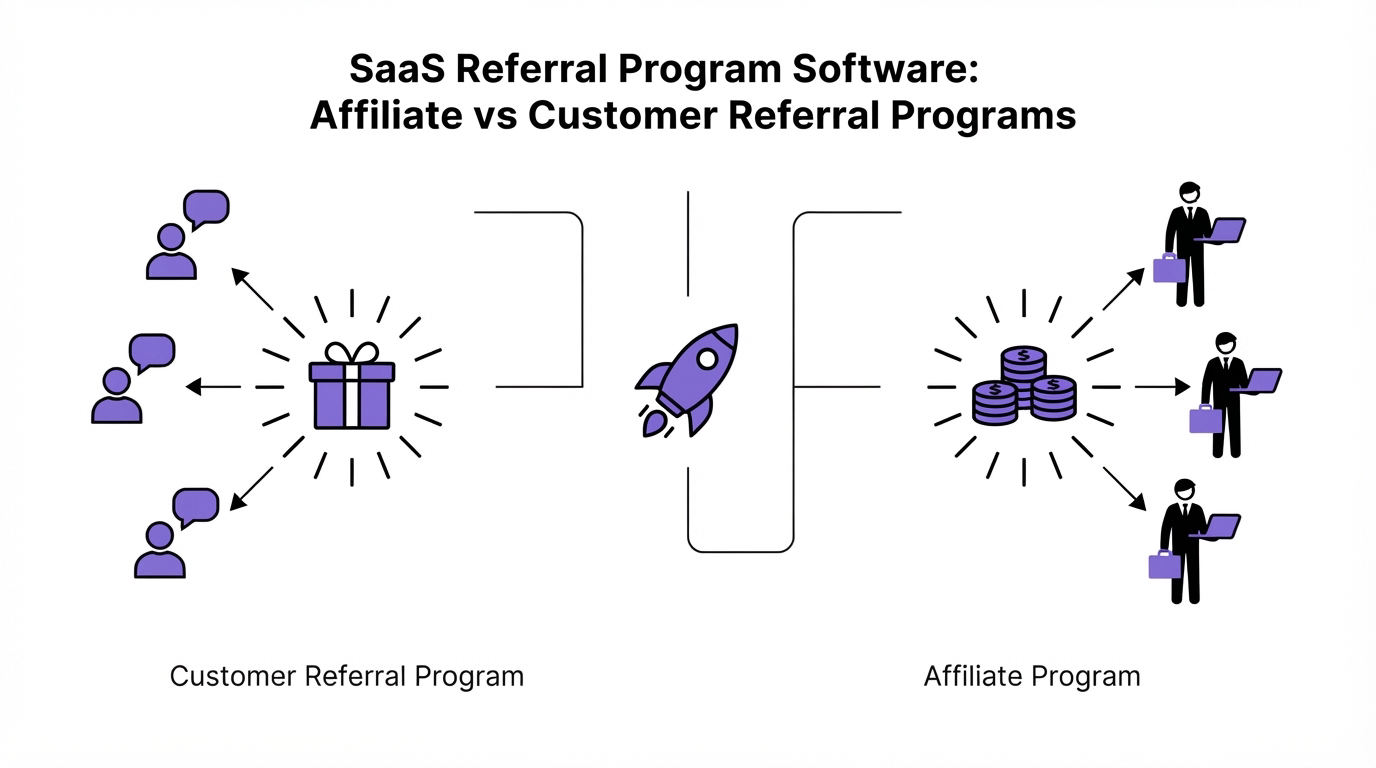
Both models reward people for introducing new customers. Their economics and operating models differ sharply.
| Program element | Affiliate program | Customer referral program |
|---|---|---|
| Primary promoter | Creators, consultants, communities, agencies, and publishers | Existing users, champions, and account owners |
| Main source of trust | Audience relevance and the promoter's expertise | First-hand product experience and peer relationships |
| Typical incentive | Cash commission, often recurring for subscription revenue | Account credit, upgrade credit, gift card, or shared reward |
| Attribution method | Referral link, coupon code, landing page, and lead record | Unique invite link, email invite, referral code, or in-product sharing |
| Recruitment work | Prospecting, applications, review, enablement, and relationship management | Product prompts, lifecycle emails, and customer success outreach |
| Scale pattern | Can reach new audiences quickly | Grows with active customer adoption and satisfaction |
| Main operational risk | Low-quality promotion, coupon leakage, and disclosure failures | Self-referrals, duplicate accounts, and rewards before retention |
An affiliate program fits a SaaS company that needs reach beyond its customer base. For example, agencies may recommend a reporting platform to many clients, and a niche newsletter can introduce the product to a defined professional audience. The promoter usually expects a clear commission schedule and reliable reporting.
A customer referral program fits products with a strong activation moment and a user base that regularly shares workflows with peers. Users refer when the product solves a visible problem, such as helping a marketing team finish monthly reporting faster.
Run both models when each has a separate offer, landing page, and measurement view. A blended program with one generic reward tends to create confusion. Affiliates need commercial terms; customers need a simple, credible reason to make an introduction.
For the broader setup sequence, see how to start an affiliate program for SaaS.
Step 1: define who will promote your SaaS product
Start with the buyer journey. Ask who already has the right to recommend your product and why their audience would listen.
Consider SignalNest, a hypothetical $79-per-month SaaS reporting tool for marketing agencies. Its founders initially plan to reward every referrer with 20% recurring commission. That sounds simple, yet it creates two very different programs:
An agency consultant may publish a tutorial, add SignalNest to a client stack, and expect monthly cash commissions because referrals form part of a commercial relationship. A working customer may mention SignalNest in a private Slack group or invite a former colleague. That customer may value a $20 account credit more than a monthly payout.
Map promoters into groups before selecting software settings. Affiliates often need an application and manual approval. Customer advocates usually need access from their account, an email, or a customer success conversation. Some power users deserve affiliate-style terms, though they began as customers.
Keep the message aligned with the promoter. Give affiliates product positioning, tracked links, audience examples, and brand guidelines. Give customers a short invitation message, a clear reward, and a sharing moment that follows a successful outcome.
Step 2: design affiliate and customer referral incentives
Tie the reward to the behavior you need and the value created. Subscription businesses commonly choose a recurring percentage for affiliates, since it motivates partners to send customers with a strong fit. Customer referrals often use a two-sided credit, where the new customer receives a benefit and the advocate earns a reward after activation or payment.
For SignalNest, the team could offer approved agency affiliates 20% of collected subscription revenue for 12 months. Existing customers could receive $20 in account credit after a referred workspace pays its first invoice, while the new workspace receives $20 credit toward its second invoice. The delayed customer incentive gives the team a chance to screen out trials and duplicate accounts.
Set a fixed commission window. State whether upgrades, downgrades, refunds, pauses, and reactivations affect rewards. Record the terms where promoters can find them without asking support.
The payout threshold also needs a practical purpose. A $50 threshold can reduce small-payment administration, while a lower threshold may improve early affiliate engagement. Choose a level that matches referral volume and finance capacity.
Avoid incentives that create an immediate loss on low-margin plans. Model the likely commission or credit against acquisition cost, support load, payment fees, and expected retention. A recurring reward can work well when the program tracks actual subscription payments and reverses rewards associated with refunds.
Read the detailed feature and setup considerations in SaaS affiliate program software: features, costs, and setup.
Step 3: set attribution rules before referral links go live
Attribution answers a simple operational question: which promoter earns credit for this customer? The answer becomes complicated when someone clicks an affiliate tutorial, joins a trial days later through a customer invite, then enters a coupon at checkout.
Write a hierarchy that your team can apply consistently. SignalNest might use the most recent valid referral link within a 30-day window, with a manually approved exception for an affiliate who documented a direct introduction. The company may decide that customer invite links take precedence when they are used during signup. The policy itself can vary. Consistency is what protects promoter trust.
Store the referral identifier against the lead, account, subscription, and payment wherever your billing architecture allows. For Stripe-based SaaS, subscription lifecycle events provide the operational signal for commissions. Stripe documents the subscription events used for billing workflows in its subscription webhooks guide.
Define these rules in writing:
- The cookie or attribution window and the event that starts it.
- The handling of direct referrals, coupon codes, and sales-assisted leads.
- The event that qualifies a reward, such as a paid invoice or passed refund period.
- The treatment of refunds, chargebacks, canceled subscriptions, and account merges.
- The process for self-referrals, related accounts, and suspected abuse.
Affiliate disclosures deserve the same level of care. Promoters should clearly disclose paid relationships when they recommend the product. The FTC's Disclosures 101 guidance provides practical disclosure expectations for social media endorsements.
Step 4: connect recurring commissions to subscription events
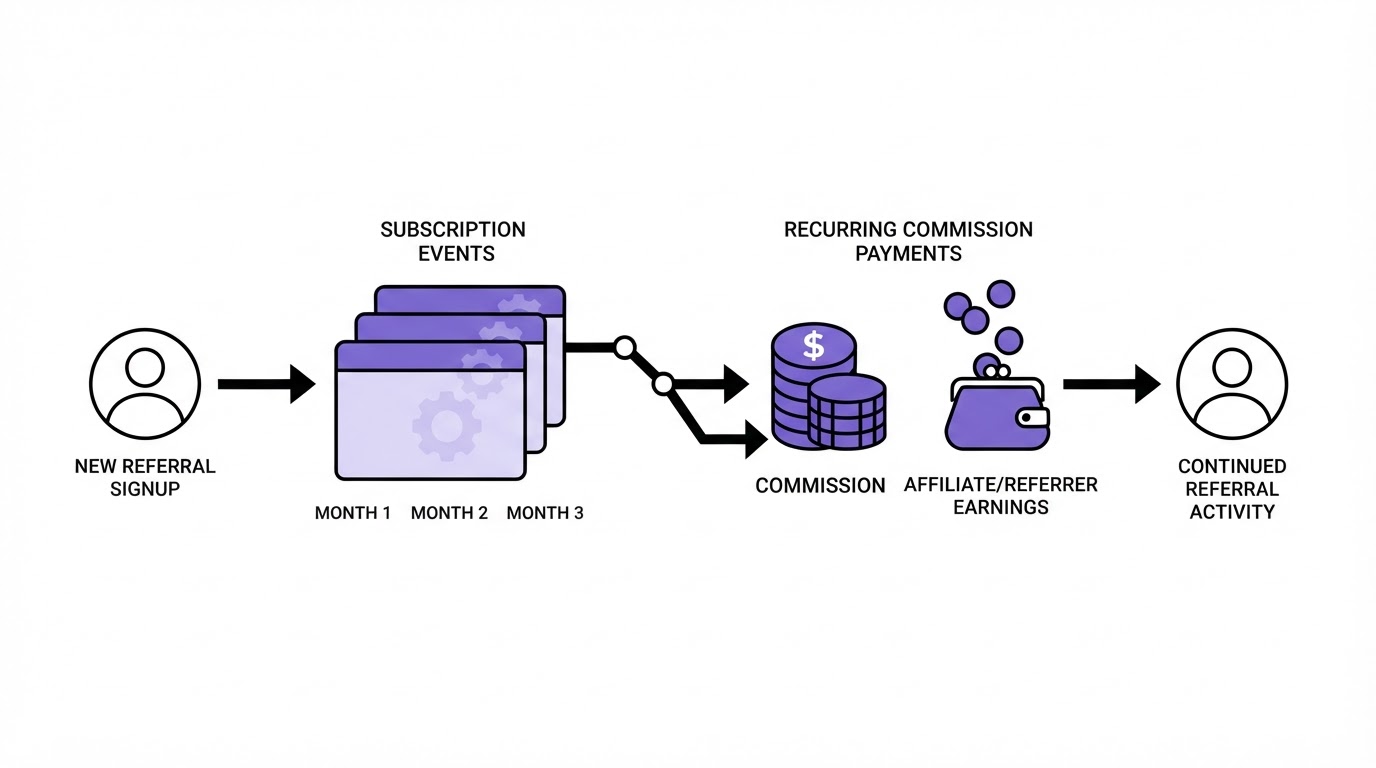
Recurring commission programs require more than a tracking link. They require a dependable link between the referral record and each qualifying payment.
For SignalNest, an affiliate earns 20% only after Stripe records a successful invoice payment. The referral system should then calculate the eligible commission, hold it through the refund window, and reverse or adjust it when a payment is refunded. A canceled subscription ends future commissions under the stated 12-month term.
Customer referral rewards need similar timing. Granting $20 immediately at trial signup invites abuse and leaves the company rewarding accounts that never become customers. Trigger the credit after the first paid invoice, then apply the credit under the billing rules you have communicated.
Test edge cases before launch. Create a test customer who upgrades from monthly to annual billing. Create another who pays, receives a refund, and later resubscribes. Confirm that the promoter record remains linked to the right account and that staff can explain the resulting reward decision.
Teams using Stripe can find a deeper walkthrough in Stripe affiliate program software: how to track SaaS referrals.
Use customer feedback software to choose referral rewards
Referral performance often exposes a product question before it exposes a marketing problem. SignalNest may find that customers hesitate to refer colleagues because the invitee needs a feature that is still missing, such as automated client-ready exports. A larger cash reward will rarely solve that friction.
Capture the reason directly. Ask advocates why they shared, why they stopped sharing, and what a referred teammate needed during onboarding. Group recurring requests by customer segment, plan, and referral source. Agency affiliates may surface feature gaps that affect multi-client work, while self-serve customers may prioritize simpler reporting or invitations.
A product team can route those submissions into customer feedback software for feature voting and public feedback boards so users can add context, vote on requests, and see which ideas are being considered. A public roadmap can also help customer advocates explain where the product is headed without promising dates that the team cannot support.
For SignalNest, the founders could add “client-ready exports” to a feedback board, invite agencies and customer advocates to vote, then review that evidence alongside referral conversion data. If the request appears frequently among stalled referrals, it becomes a concrete input for product prioritization and partner enablement. This creates a feedback loop between product adoption and referral growth.
How ReferClaw supports a SaaS referral program workflow
A purpose-built system reduces spreadsheet reconciliation and inconsistent reward decisions. With ReferClaw, the workflow should mirror the operating choices already made by the team.
Start by connecting the billing setup and defining the affiliate or customer campaign. For SignalNest, that means one affiliate campaign with 20% recurring commission for 12 months and one customer campaign with a $20 account credit after the first paid invoice.
Next, create the referral links and sharing paths for each group. Affiliates receive links for their articles, tutorials, and client recommendations. Customers receive a simpler invitation path suited to peer sharing. Keep the offers separate so their terms remain easy to understand.
Then configure the qualifying payment event and hold period. The program records conversions against the referral source, calculates rewards from subscription activity, and gives the team a review point before payouts or credits are finalized. Staff can investigate a suspicious SignalNest signup before approving the reward.
Finally, review results by campaign rather than relying on one program-wide number. Compare activation, paid conversion, retention, refund rate, and reward cost across affiliates and customer advocates. ReferClaw's comparison resources and low-cost affiliate software comparison can help teams frame the capabilities they need when assessing platforms, including alternatives such as Rewardful and Tolt.
Step 5: run the operational work behind the program
Referral software handles tracking and calculations, while program health still depends on human decisions. Assign clear ownership across marketing, finance, support, and product.
Marketing owns recruitment, promoter education, and campaign messaging. Finance owns payout review, tax documentation where required, and reconciliation. Support needs a documented response for missing credit, disputed attribution, and delayed payouts. Product owns the referral moments in onboarding and the feedback loop that improves them.
SignalNest should review a short monthly report: approved promoters, referred trials, first paid invoices, retained subscriptions, refunds, and pending reward disputes. A high trial count paired with low first-payment conversion may signal weak audience fit. A high refund rate from one affiliate may justify a conversation, a changed landing page, or removal from the program.
Common failure modes include paying before revenue is collected, allowing uncapped self-referrals, and applying different attribution decisions to similar cases. Write the policy, train the support team, and preserve an audit trail for every manual adjustment.
FAQ
Should SaaS companies run both an affiliate program and a customer referral program?
Yes, when the company has both an external audience channel and engaged customers who can recommend the product. Run separate campaigns with separate reward terms, referral paths, and reporting. This preserves clarity for promoters and makes performance analysis more useful.
What is a good recurring affiliate commission for SaaS?
The appropriate rate depends on gross margin, support cost, refund behavior, sales involvement, and expected retention. Build a model from collected subscription revenue, then set a commission duration and rate that remain viable if the referred customer upgrades, downgrades, or requests support.
When should a customer referral reward be paid?
Pay after a meaningful value event, usually the first successful paid invoice and any refund-review period your terms require. This timing reduces duplicate-account abuse and focuses rewards on customers who reach paid adoption.
Can Stripe track affiliate and customer referrals by itself?
Stripe provides payment and subscription events that support reward calculations. Referral attribution, promoter links, campaign rules, fraud review, and payout operations require a dedicated workflow around those billing events. Use the payment record as the financial source of truth.
How long should a SaaS referral attribution window be?
Choose a window that reflects the normal buying cycle. A short self-serve trial may justify a 14- or 30-day window. Enterprise or agency-led sales may need a longer period plus a documented manual attribution process for qualified introductions.
Choose the model that matches your growth source
Use an affiliate program when trusted publishers, consultants, and agencies can introduce your SaaS to new audiences. Use a customer referral program when active users have a strong product experience worth sharing. For many SaaS companies, separate programs provide the clearest path.
Set the incentive, attribution rules, subscription events, and review process before recruitment begins. Then use SaaS referral program software that can keep referral records and billing outcomes connected as the program grows. Read next: Affiliate Program Pricing for SaaS: Revenue Share vs Monthly Plans.