
Affiliate Program Pricing for SaaS: Revenue Share vs Monthly Plans
M
By Matthew
Referral tracking and attribution writer
Published November 12, 2026 · Last updated November 12, 2026
By Matthew
A SaaS affiliate program can look inexpensive at launch, then become one of the larger variable costs in your growth budget as referred subscriptions accumulate. The software fee, affiliate commission, payment-processing charge, and payout cost can all land in different places on a monthly statement.
For teams running subscriptions through Stripe, ReferClaw provides a capped pricing model designed to keep affiliate software costs predictable as program revenue grows.
Quick answer: how to compare affiliate program pricing for SaaS
Use this workflow before choosing a platform:
- List every monthly software charge: base subscription, usage fee, and any revenue-based fee.
- Calculate affiliate commissions from collected subscription revenue, including renewals if you offer recurring commission.
- Add payout costs for the method and frequency you will use.
- Check whether refunds, chargebacks, taxes, and failed payments reverse tracked commissions.
- Model three months: launch volume, expected volume, and a high-growth month.
- Compare the maximum monthly platform cost, especially where a revenue cap applies.
- Choose the plan whose total cost and operational work fit your program at the volume you expect in the next 12 months.
The platform subscription is only one line in the calculation. Your commission policy usually drives the largest spend, while transaction-based software fees create the biggest forecasting risk when referral revenue rises quickly.
What makes up affiliate program pricing for SaaS
SaaS affiliate pricing usually combines fixed and variable costs. Get each component in writing before you publish program terms or promise a commission rate to partners.
| Cost component | How it is usually charged | What to model | Common budgeting risk |
|---|---|---|---|
| Base platform fee | Flat monthly amount | Fee due even with zero referred sales | Paying for capacity you will not use early on |
| Transaction or tracking fee | Percentage of referred revenue or conversions | Referred monthly recurring revenue and annual prepay orders | Cost rises alongside your strongest acquisition channel |
| Affiliate commission | Percentage or flat amount per qualified customer | Commission rate, duration, refunds, and renewal behavior | Promising lifetime or recurring payouts without a margin model |
| Payout fee | Per transfer, percentage, or both | Number of paid affiliates and payment frequency | Small balances create many low-value transfers |
| Revenue cap | Maximum charge for a defined billing period | Highest possible platform fee at scale | Treating a cap as a limit on affiliate commissions rather than a limit on software charges |
Fixed monthly plans
A fixed plan gives finance a known platform bill. This structure works well when referral volume is already steady and the plan includes the tracking, fraud review, partner management, and payout workflow you need.
The trade-off is simple: a flat fee begins before your first converted customer. A founder launching with five partners may prefer a smaller commitment, while a business with established partner demand may value stable operating costs.
Revenue-share or transaction fees
Some affiliate tools charge a percentage of tracked referral revenue, a per-conversion fee, or a usage tier that rises with volume. This can lower the cost of starting a program because software spend follows early results.
Forecast it carefully. A $50,000 month of affiliate-attributed recurring revenue at a 1% software fee produces a $500 platform charge before affiliate commissions and payout fees. At $200,000, the same fee becomes $2,000.
Revenue-share pricing can be reasonable when it includes services your team would otherwise perform manually. It needs a ceiling if your forecast includes rapid growth or annual-plan purchases.
Payout fees and payment operations
Affiliate commission and payout fees are separate expenses. A 20% recurring commission rewards the affiliate. The payment provider may also charge for each transfer, currency conversion, or payment method.
Set a minimum payout threshold, such as $50, when small balances would create disproportionate processing work. Pay on a clear schedule after your refund window closes. Keep enough time between a customer payment and affiliate payout to account for disputes, refunds, and failed renewals.
Stripe Connect supports platforms that need to move funds to connected accounts, and Stripe documents the available payout schedules and timing. Your own setup determines which fees and timing rules apply.
Worked example: compare monthly fees, revenue share, and a cap
Consider BeaconMetrics, a fictional B2B reporting SaaS. Its Growth plan costs $200 per month. The company recruits 12 affiliates and offers 20% recurring commission for the first 12 paid months of each referred customer.
In month six, affiliates have referred 50 paying customers. BeaconMetrics collects $10,000 in subscription revenue from those customers during the month. Two customers receive refunds totaling $400 within the approved refund period, so eligible commission revenue is $9,600.
Affiliate commission is $1,920: 20% of $9,600. That cost belongs in the acquisition model regardless of which software platform the team uses.
Now compare three illustrative software billing structures:
- A flat $199 monthly plan produces a $199 software cost.
- A 1% revenue-based fee on the $9,600 eligible amount produces a $96 software cost.
- A capped model can begin with a variable charge and stop increasing once it reaches its monthly maximum.
The first two options are easy to calculate at this volume. The decision changes when BeaconMetrics grows. Assume its eligible referred revenue reaches $120,000 in a later month. The 20% affiliate commission reaches $24,000. A 1% platform fee reaches $1,200.
A capped model gives the finance owner a maximum software exposure for that month. The commission can still grow because more referred subscriptions are paying, while the platform charge stops at the cap specified in the plan. Confirm the current ReferClaw cap and plan terms directly on the ReferClaw website before placing a number in your forecast.
BeaconMetrics also pays 25 affiliates that month. If its selected payout route costs $0.25 per transfer, payout fees add $6.25. The full monthly calculation is therefore commission plus software fee plus payout costs, adjusted for refunds and reversals.
One operational issue appears here: the company initially counted its $10,000 in gross receipts before removing refunds. Its partner terms used collected, eligible revenue. Fix the reporting definition before approving payouts, then use the same definition in forecasts, partner statements, and accounting reviews.
How to choose the right SaaS affiliate pricing model
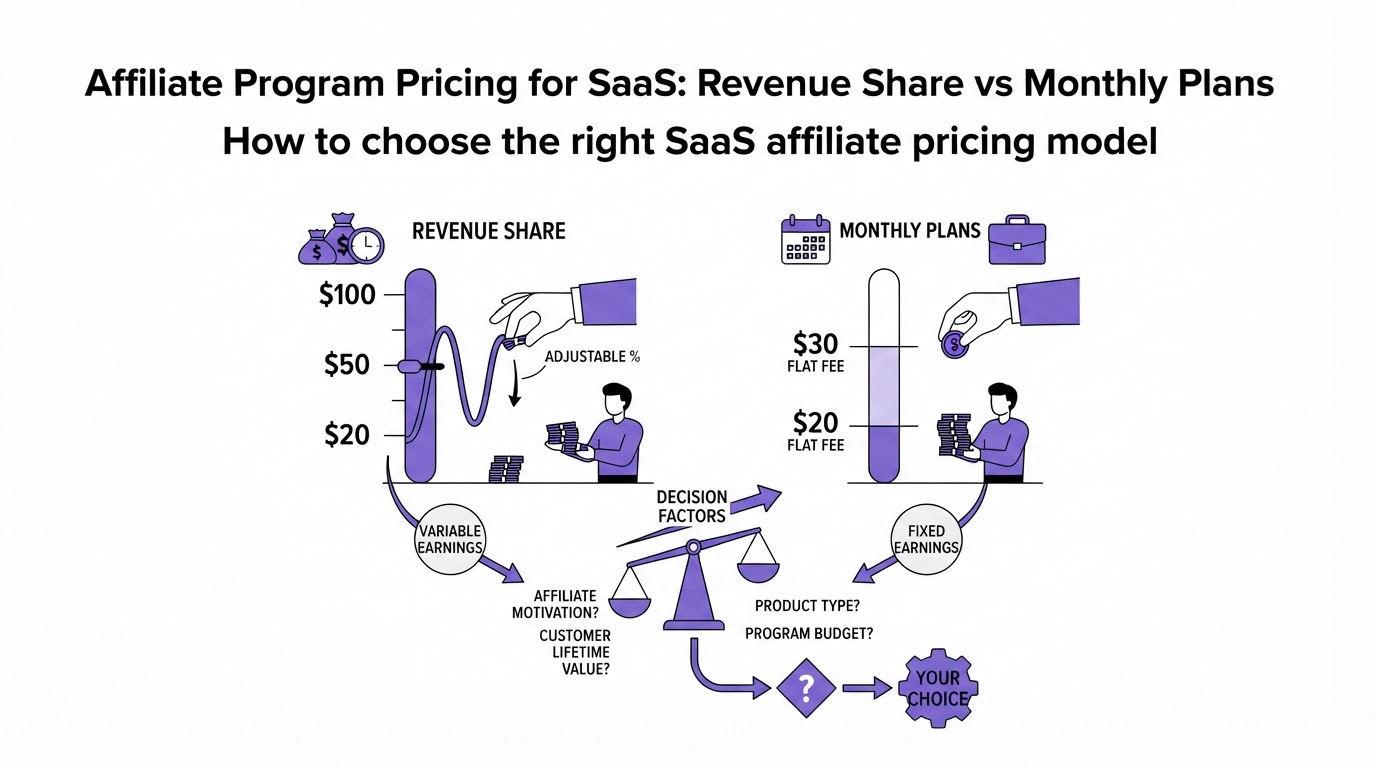
Start with your unit economics. If your gross margin after hosting, support, payment processing, and sales costs leaves room for a 20% recurring commission, the offer may be sustainable. If annual plans include deep discounts, calculate commission from the actual amount collected rather than the list monthly price.
Export the last 90 days of subscription data first. Split it by monthly plans, annual plans, refunds, failed payments, and upgrades. Then make a 12-month referral model using conservative, expected, and high-growth customer counts.
For each model, include the following inputs in a spreadsheet: average collected revenue per referred account, commission percentage, commission duration, expected active affiliates, payout threshold, software base fee, variable software fee, and monthly cap. Review the result with the person who owns subscription revenue recognition.
A platform that tracks recurring revenue accurately matters because a new referral can generate many commission events over time. Read our guide to Stripe affiliate program software and SaaS referral tracking for the event flow behind those numbers.
Revenue caps make growth costs easier to forecast
A cap has value when your affiliate channel works. It limits the software charge after a stated amount, giving the team a usable upper bound for scenario planning.
Read the plan language closely. Check the billing period, the revenue definition, whether the cap applies to all fees or only a particular variable fee, and whether annual subscriptions count when payment is collected. Ask how upgrades, downgrades, and prorations appear in reporting.
Do the same work for commission rules. A software cap changes the platform expense. It does not reduce what you owe an affiliate under a valid commission agreement.
How ReferClaw handles capped affiliate program pricing for SaaS
Teams that want to operate a program themselves still need to connect billing, define commissions, issue referral links, review conversions, and prepare payouts. ReferClaw focuses this workflow around SaaS referral tracking while keeping the software cost bounded through its capped model.
Begin by connecting the subscription billing flow and defining the conversion event that earns a commission. Use collected-payment rules that match your refund policy, then set the recurring commission terms you can support from gross margin.
Next, invite affiliates and give them tracked links. When a referred customer starts paying, review the tracked sale and its commission record before the payout window. This keeps refunds and disputed payments from reaching an affiliate payout queue too early.
As the program grows, use the cap as a budgeting guardrail in your forecast. You can then focus attention on partner quality, commission terms, and payout governance instead of trying to estimate an open-ended percentage software charge every month.
If you are evaluating alternatives, the ReferClaw comparison page provides a starting point. You can also review specific comparisons for Tolt and Rewardful while checking each vendor's current plan details on its own pricing page.
For the broader setup sequence, use our practical guide on how to start an affiliate program for SaaS. It covers the decisions that come before pricing, including partner recruitment and program rules.
Common mistakes when budgeting SaaS affiliate program costs
The most expensive errors tend to appear after the first successful month, when program rules are still vague and the referral balance has grown.
First, teams budget only for the platform subscription. Add commissions, transfer costs, staff review time, fraud checks, and finance reconciliation. A low platform fee cannot make an unsustainable commission offer profitable.
Second, they offer “lifetime” recurring commissions without defining the customer lifecycle. Write down what happens after a cancellation, reactivation, plan downgrade, refund, account transfer, or self-referral. Use a fixed term when lifetime economics remain uncertain.
Third, they pay from signup counts instead of qualified payments. A signed-up trial has no collected subscription revenue. Define the exact event that creates a payable commission and the date when it becomes eligible.
Fourth, they treat affiliate and customer referral programs as interchangeable. Affiliates often earn cash commissions, while customers may receive account credit, discounts, or product access. Each approach has different margins, incentives, and tax handling. Our guide to affiliate versus customer referral programs for SaaS explains when each model fits.
FAQ
How much should a SaaS company pay affiliates?
Many SaaS programs use a percentage of collected subscription revenue, a flat bounty, or a hybrid. Choose the amount from contribution margin and expected retention. A 20% recurring offer can work for a high-margin product with durable retention, while a shorter commission term may suit products with higher service costs or lower retention.
Should recurring affiliate commissions apply to annual plans?
They can, provided the terms explain the calculation clearly. Pay commission on the annual amount collected, then apply your refund window before approving the payout. A yearly payment can create a larger one-time commission expense, so include annual-plan mix in the cash forecast.
What is included in a SaaS affiliate software fee?
The answer depends on the vendor and plan. Review whether the fee covers tracking, recurring commission calculations, affiliate links, partner portals, conversion review, payout preparation, and reporting. Also check for per-transaction charges, revenue-based charges, minimum commitments, and caps.
How do I avoid overpaying affiliate commissions after refunds?
Set a payout approval delay that extends beyond your normal refund window. Track commission eligibility from the collected payment event, reverse commissions tied to approved refunds, and document the process in your affiliate terms. Your payment data should remain the source of truth for the final approved amount.
Is a capped plan better than a flat monthly plan?
A capped plan can suit a program whose referral revenue may grow quickly because it creates a maximum platform cost. A flat plan can suit a mature program with stable volume and feature needs. Run both against your conservative, expected, and high-growth cases before deciding.
Choose a pricing structure after you have modeled the whole program cost. If you want recurring SaaS referral tracking with a capped software charge, visit ReferClaw and map the plan terms against your commission policy before launch.