
Low-Cost Affiliate Software: ReferClaw vs Rewardful, Tolt, and FirstPromoter
S
By Sophie
Partner program operations contributor
Published November 14, 2026 · Last updated November 14, 2026
By Sophie
A SaaS affiliate program can become expensive before it produces a meaningful pipeline. Teams often commit to a plan, build affiliate links, and later discover that recurring subscription events, payout approvals, or program limits require a higher tier.
Low cost affiliate software should keep fixed overhead predictable while tracking the subscription events that determine commissions. ReferClaw helps buyers compare these trade-offs through a focused set of SaaS affiliate software comparisons.
Quick answer: how to choose low cost affiliate software
Use this workflow to select a platform without creating an expensive migration project later.
- Map the commission event: first payment, every renewal, a fixed number of months, or a one-time bounty.
- Export a 90-day forecast of affiliate-driven subscriptions and calculate the maximum monthly tool cost your program can support.
- Confirm how the platform receives Stripe subscription, refund, cancellation, and payment-failure events.
- Test the affiliate journey from link click through signup, payment, attribution, approval, and payout export.
- Compare plan limits, support level, and operational work using a dated vendor quote before signing.
- Choose the simplest platform that supports your current commission policy and the next program milestone.
What low cost affiliate software needs to handle for SaaS
For a content site selling one-time products, affiliate tracking can end at a completed order. SaaS programs need a longer record. The referring partner needs credit after a trial converts, a subscription renews, a refund occurs, or a customer upgrades.
Start with the policy. A $79-per-month product may pay 25% of the first payment, 25% for the first 12 paid months, or a fixed bounty after the second successful charge. Each policy creates different tracking and finance requirements.
Consider LumaBoard, a fictional B2B reporting SaaS that bills through Stripe at $79 per month. Its initial plan pays affiliates 25% for 12 months after a referred account becomes paid. The team has eight active partners and expects more content creators after launch. A one-time commission tool appears cheaper in a demo, yet it leaves LumaBoard with a manual renewal ledger. That work grows every billing cycle.
A suitable platform should cover these four jobs:
- Capture referral attribution at the click and carry it through signup.
- Match a paid Stripe subscription to the attributed customer.
- Apply the commission rule across renewals, refunds, and cancellations.
- Give the program owner an approval and payout process that finance can audit.
For the wider implementation sequence, use this guide on how to start an affiliate program for SaaS.
How to compare low cost affiliate software pricing fairly
A low monthly starting price tells only part of the story. Compare the cost of operating the program over the same period as your commission policy. For LumaBoard, that period is 12 months because every qualified referral can earn recurring commission through month 12.
Ask each vendor for a written, dated answer covering the current monthly plan, included affiliate or conversion limits, overage rules, payout fees, contract term, and required add-ons. Save the response with the date. Public plan pages and checkout flows change, especially where volume tiers apply.
This table gives a consistent scorecard for ReferClaw, Rewardful, Tolt, and FirstPromoter. It avoids stale price claims and focuses on evidence a buyer can verify before purchase.
| Platform | Pricing evidence to collect | Stripe and subscription workflow to test | Best-fit scenario | Cost risk to investigate |
|---|---|---|---|---|
| ReferClaw | Current plan quote, included usage, billing term | Referral attribution through paid subscription status and commission lifecycle | SaaS teams seeking a focused evaluation path for a lean affiliate program | Plan limits that arrive as partner recruitment accelerates |
| Rewardful | Published plan and current checkout quote | Subscription attribution, recurring commission rules, refund handling | Stripe-centered SaaS teams with a defined commission model | Tier changes tied to program scale or feature access |
| Tolt | Published plan and current checkout quote | Stripe event handling, partner portal workflow, payout approval | Teams that want a polished affiliate experience with managed operations | Higher plan needs once automation or program complexity expands |
| FirstPromoter | Published plan and current checkout quote | Subscription conversion, upgrades, and recurring rewards | SaaS programs that need broader partner-program controls | Paying for functionality the first launch phase will not use |
Price evidence needs context. A platform with a higher monthly fee can reduce finance work, reconciliation mistakes, and missed commission adjustments. A lower fixed fee can be the stronger choice when the program has a small partner base and a straightforward rule set.
Read Affiliate Program Pricing for SaaS: Revenue Share vs Monthly Plans before deciding between fixed software spend and a pricing model tied to program activity.
Test Stripe tracking before you recruit affiliates
Stripe integration deserves a real test account, not a checkbox review. The affiliate platform needs a reliable way to learn when an attributed lead becomes a paying subscriber and when the revenue later changes.
For LumaBoard, create a test affiliate link and use a separate customer email. Click the link, create an account, begin a trial, and complete a Stripe checkout. Then inspect the affiliate record and commission record. Repeat with a refunded payment and a canceled subscription.
Ask each vendor these operational questions during the trial:
- Which Stripe event creates a conversion, and can the rule be adjusted?
- When does a commission become payable after a refund window?
- How are failed payments, upgrades, downgrades, and cancellations treated?
- Can the team trace a commission back to the Stripe customer and subscription?
- Can finance export approved payout data with a clear audit trail?
Stripe recommends verifying webhook signatures and handling duplicate events safely in its webhook documentation. Your affiliate tool may manage parts of that connection, while your own product and billing setup still need a clear source of truth for customer status.
LumaBoard's first test exposes a common failure mode: its trial starts before payment details are collected. The team must confirm whether attribution persists from trial signup to the later paid subscription. Run this test before issuing links to partners. Retrofitting attribution after a public launch creates support cases that are difficult to settle fairly.
For a deeper Stripe-specific checklist, see Stripe Affiliate Program Software: How to Track SaaS Referrals.
Set recurring affiliate commissions without creating disputes
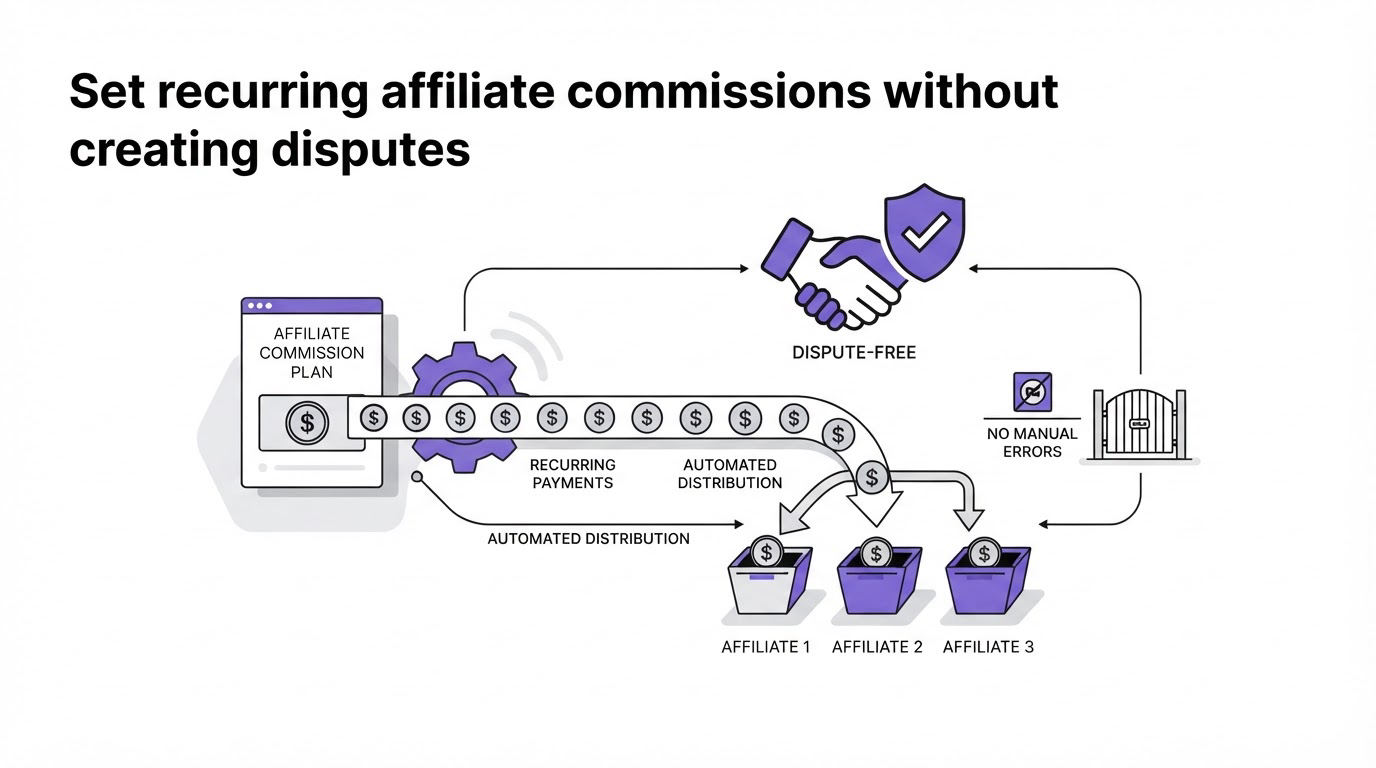
Recurring commissions attract partners because they align with subscription value. They also need precise written terms. State the percentage, commission duration, qualifying payment event, refund treatment, payout threshold, and payment schedule in the affiliate agreement.
For LumaBoard, “25% for 12 months” needs six decisions: whether month one begins at trial conversion or first invoice; whether annual billing earns on the full charge; whether discounts reduce commissionable revenue; how refunds reverse earnings; whether upgrades qualify; and whether a canceled account that later returns restores attribution.
Keep the rule simple for the first launch. A first-payment bounty or a fixed number of recurring months is easier to explain and audit than a policy filled with exceptions. Add advanced partner tiers after the team has reviewed real conversion and payout data.
Affiliates also need clear disclosure instructions. The U.S. Federal Trade Commission explains that material connections should be disclosed clearly and conspicuously in its Disclosures 101 guidance. Put a short disclosure requirement in the program terms and partner onboarding materials.
ReferClaw vs Rewardful, Tolt, and FirstPromoter: how to use the comparison pages
Buyer research creates its own workload. Pricing language varies, feature labels overlap, and a demo can skip the edge cases that later fall on operations. ReferClaw's comparison hub makes the evaluation process more structured without asking a SaaS team to collect every comparison from scratch.
Start at the ReferClaw comparison hub and choose the vendor already on your shortlist. Open the Rewardful comparison, the Tolt comparison, or the FirstPromoter comparison. Read each page beside your written commission policy rather than treating feature lists as a decision on their own.
Then take the criteria from the earlier table and record the vendor's current answer for your exact workflow. For LumaBoard, the decision sheet would include: 25% recurring commission, 12-month duration, trial-to-paid attribution, Stripe refund treatment, payout export, and the current monthly plan quote. That turns a broad comparison into a procurement record.
Finally, run the same test journey in the shortlisted product. The winning option is the one that lets LumaBoard trace a test customer from partner link to Stripe payment and payout approval with the least manual correction. This approach gives a lean team a defensible way to choose low cost affiliate software while keeping future migration risk visible.
When each platform may fit your SaaS program
ReferClaw fits buyers who want a focused way to assess SaaS affiliate options and pressure-test the operational requirements before committing. Use the comparisons to narrow the field, then validate the live workflow with a test customer.
Rewardful is often considered by SaaS teams that run Stripe billing and want affiliate tracking centered on subscription revenue. Confirm the precise plan requirements for your expected scale and commission structure directly with the vendor.
Tolt often enters the shortlist when the partner-facing experience and program administration are priorities. Review its current plan boundaries alongside the effort required to support affiliates, approve conversions, and issue payouts.
FirstPromoter can suit teams evaluating a broader partner-program approach. Check whether the features you need for launch sit on the plan you are considering, then estimate whether the extra controls will be used in the first year.
A customer referral program may call for a separate workflow. Customers and professional affiliates respond to different rewards, messaging, and qualification rules. The guide to SaaS referral program software: affiliate vs customer referrals explains where those programs should diverge.
FAQ
What is the cheapest way to start a SaaS affiliate program?
Start with one clearly defined commission policy, a small group of vetted affiliates, and a platform that can track your Stripe subscription lifecycle. Keep the launch scope tight. LumaBoard can begin with eight partners, one 12-month recurring offer, and a monthly payout review before adding tiers or referral campaigns.
Should SaaS companies pay recurring affiliate commissions?
Recurring commissions can work well when retention is strong and the margin supports the payment over time. Set a fixed duration, such as 12 months, for the first version of the program. This gives partners a compelling offer and keeps the liability measurable.
Can I run an affiliate program and a customer referral program together?
Yes. Use separate terms, reward structures, and tracking rules. Affiliates may require payout reporting and promotional assets, while customers often respond better to account credit or a simple referral reward. Keep the program identities clear in your product and communications.
What should I ask during an affiliate software demo?
Ask the vendor to show a referral link click, trial signup, paid Stripe conversion, recurring commission, refund reversal, partner approval, and payout export. Use your own commission policy during the demo. Generic workflows can hide important gaps.
When should I switch affiliate software?
Plan a switch when manual reconciliation, plan limits, missing billing events, or payout errors consume enough time to threaten program trust. Export affiliate records, links, attribution data, commission history, and payout status before making the change. Preserve existing partner links where your migration plan allows it.
A lean SaaS team with a simple Stripe billing model should begin with a documented policy, a tested subscription journey, and current vendor quotes. Use ReferClaw's comparisons to shortlist the right fit, then choose the platform that gives your team reliable attribution and manageable operating cost for the program you are ready to run.